


See our full list of 7 Best and Fastest SSDs
Bottom Line
Designed for read-intensive hyperscale data center applications, the XD5 SSD is a good choice when consistent quality of service (QoS), consistent read latency and consistent read of performance are important. Solutions such as the Intel Optane 4800X and the Western Digital PC SN970 may beat it for overall performance. But the Toshiba XD5 more than makes up for that due to its durability, endurance, capacity and steady work rate.
The XD5 can write almost 4 TB of data per day for five years at a steady performance rate. And it is no slouch. It’s random read/write rate of 385,000/230,000 IOPS make it ideal for enterprise storage systems that support heavy transactional workloads and other applications that demand constant writing of data at a predictable rate with reliable performance.
Product Description:
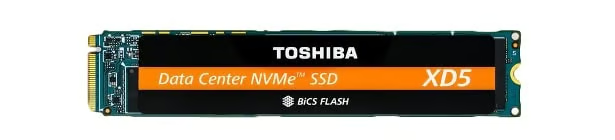
Toshiba XD5 Series Data Center NVMe SSD is a PCIe Gen 3, NVMe 1.3a specification, high-performance SSD, 1.92 TB and 3.84 TB capacities, built on BiCS FLASH TLC, available in sub-1 drive write per day.
These enterprise-class SSDs are suitable for high-performance Tier 0 computing, server and storage systems. Toshiba NAND flash memory and controllers offer high reliability, data protection, power-loss-protection and the encryption technology demanded for enterprise applications. Further pluses include light weight and low power consumption.
Features:
- Form factor: The XD5 is delivered to OEMs in a 22x110mm M.2 form factor
- Capacity: 1.92 TB and 3.84 TB
- Random Reads: 240k
- Random Writes: 90k
- Throughput: 2.5 GB/s
- Latency: 30 milliseconds
- Endurance: Writing 3.84 TB of data per day for 5 years.
- Lifespan: MTBF of 2.0 million hours of operation, five years.
- Data Protection: Toshiba SSDs have Quadruple Swing-By code, which provides ECC and LDPC for error correction and helps to extend the life expectancy of the NAND.
- Data Management: Toshiba SSDs have internal data-level reliability features, which help to protect data. QoS.
- NVMe: Supports the NVMe 1.3a specification, supports NVMe-MI (Management specification developed by the NVMe working group)
Key Markets and Use Cases:
The XD5 is a data center-class SSD, which is designed for hyperscale data center applications where consistent QoS, consistent read latency and consistent read performance are important. Predictability is more important than the highest performance. But due to its use of NVMe, performance is very good.
XD5 enterprise SSDs are suitable for high-performance Tier 0 computing, server and storage systems that require high level of performance and reliability.
The mixture of high performance and endurance see the Toshiba XD5 being used for a wide range of write intensive applications. This includes
- Big Data Analytics
- High Performance Computing
- Mainstream server and storage systems.
Warranty:
Five years
Pricing:
Starting around $200.
Toshiba XD5
See Full Table
| Product | |
|---|---|
| Capacity | 1.9 TB to 3.84 TB |
| Random Reads | 240k |
| Random Writes | 90k |
| Throughput | 2.5 Gb/s |
| Lifespan | 3.84 TB/day/5 yrs, 2 million hours |
| Price | $3,000 |
| Category | Best M.2 SSD |
| Key differentiator | Handles heavy workloads |
x
Toshiba XD5
| Product | |
|---|---|
| Capacity | 1.9 TB to 3.84 TB |
| Random Reads | 240k |
| Random Writes | 90k |
| Throughput | 2.5 Gb/s |
| Lifespan | 3.84 TB/day/5 yrs, 2 million hours |
| Price | $3,000 |
| Category | Best M.2 SSD |
| Key differentiator | Handles heavy workloads |