


As with Ethernet networks, cabling forms the backbone of the entire Fibre Channel network. If the cabling hasn’t been properly installed, the network will not function as well as it could — and sometimes won’t function at all. With cable forming such a critical part of the network infrastructure, it’s important to understand what types of cables are used for connecting Fibre Channel devices to a SAN. In this first part of a two-article series highlighting Fibre Channel cables and connectors, we take a look at copper-based cables and connectors and discuss why copper has given way to fiber as the media of choice when building SANs.
The natural assumption when talking about Fibre Channel networks is that fiber-optic cabling is used to create the network. This isn’t always the case, and in some instances, copper is the better option. Copper-based cabling has been with us since the beginning of networking, and there are several reasons why we continue to use copper cable today, including ease of installation, cost, and (on occasion) even speed.
Currently, copper-based cables are being used to implement Gigabit Ethernet networks. Gigabit Ethernet is a ratified IEEE standard that has been given the IEEE 802.3ab designation (to find out more about the IEEE organization or its various standards, refer to their website — http://www.ieee.org). Gigabit Ethernet builds on top of the Ethernet protocol using familiar Ethernet technologies, but increases speed tenfold over Fast Ethernet to 1000 Mbps, or 1 Gigabit per second (Gbps). It is important to note that Gigabit speeds are only achievable using category 5, 5e, and higher UTP cable. This is because each of the four pairs of wires within Category 5 cable is used to transmit 250Mbps. Lower grade cables such as Category 3 do not contain as many wire sets and therefore cannot be used for gigabit transmissions.
The obvious question becomes, if it is possible to implement Gigabit speeds using Ethernet infrastructure and low-cost category 5 cable, why would we need to use fiber optic media? For the answer to this, we can look back to the inherent limitations of our Fast Ethernet networks and copper cable. Some of these limitations include:
- Susceptibility to the effects of electromagnetic interference (EMI) and crosstalk — Since the beginning of networking, crosstalk and EMI have been the Achilles heels for copper-based cable. Crosstalk occurs when signals from two cables in close proximity to one another interfere with each other. As a result, the signals on both cables may become corrupted. EMI is even more common than crosstalk and is caused by any device that creates an electromagnetic field. This means that copper cables that run too closely to florescent lights or even computer monitors can experience signal degradation within the cable. Fiber media has no such concerns.
- Low Attenuation — As a signal passes through a given media, the signal weakens as it travels further away from the point of origin. This is known as attenuation. Copper-based cables have very low attenuation, and in regard to Category 5 and 5e cable, it is only recommended to run 100 meter lengths — beyond that the signal within the cable degrades. Compare this to fiber optic cable where acceptable distances are measured in Kilometers.
- Transmission Integrity and Security — As mentioned, copper-based media is susceptible to outside interference such as EMI and crosstalk. This increases the transmission error rates for copper cable. Because fiber cable is immune to outside interference, it has a very low transmission error rate — approximately one error per trillion bits, in fact! Furthermore, it is far easier to electronically eavesdrop on copper cable than on optical transmissions. Wherever security is a concern, fiber is the best option.
Despite the shortcomings of copper cable, it is certainly kept in the loop. Gigabit Ethernet using copper cable can provide a cost-effective LAN backbone, allowing organizations that have invested in copper cable infrastructures to further leverage their investments. Previously, moving beyond the 100Mbps LAN barrier was far too costly for many organizations in terms of hardware, technical expertise, and time. Achieving speeds beyond Fast Ethernet required costly fiber optic technologies such as ATM or 1000Base SX/LX.
Page 2: Copper-based Cabling in SANs
Copper-based Cabling in SANs
When copper cables and copper-based Fibre Channel devices are used in a SAN, we attach them to other Fibre Channel devices using two types of connectors, Copper Gigabit Interface Connectors (GBICs) and Media Interface Adapters (MIAs). Copper GBICs are hot pluggable connectors that attach to Fibre Channel devices using either a DB-9 or the High Speed Serial Data Connector (HSSDC). Shown below are examples of copper GBICs and the associated connector type.
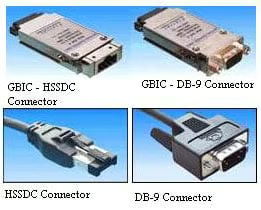
There are two different types of copper GBIC connectors, each with a unique purpose. The first type is the intracabinet GBIC, which as you might have guessed, is used to connect devices located within a cabinet. Intracabinet GBICs are used when you need to connect Fibre Channel devices close together, typically no more than 13 meters apart. Intracabinet GBICs are considered passive devices, as they do not regenerate transmitted signals; they simply pass the signal from one device to another.
The second type of GBIC connector is the intercabinet GBIC. Intercabinet GBICs are used to connect devices that stretch beyond 13 meters and are considered active devices, as they are capable of regenerating a signal before it is passed. In addition, intercabinet GBICs are able to detect and report signal loss and transmission errors. As you might expect, the increased abilities of the intercabinet GBICs add to their cost, making them much more expensive than their intracabinet counterparts.
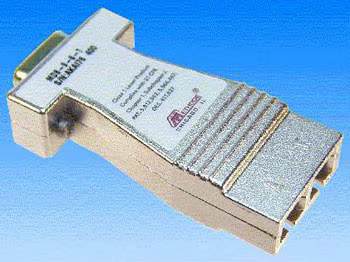
The second type of connector used to connect copper cables to Fibre Channel devices is the Media Interface Adapter (MIA). There are two key functions of the MIA connector. The first is to attach Fibre Channel devices with a copper interface to optical fiber links. Essentially, MIAs convert a Fibre Channel copper interface to an optical one. The second function of the MIA is to extend the distance of a Fibre Channel link. MIAs can only be attached to Fibre Channel devices using the DB-9 connector and do not support the HSSDC connector type. Shown below is an example of an MIA connector.
Copper vs. Fiber in SANs
Implementing copper is certainly cheaper and perhaps easier than fiber; however, copper-based cable cannot match fiber cable in terms of speed, error free transmissions, and security. Because of these reasons, fiber cable has emerged as the media of choice for storage networks, with copper media filling where it can. In the next Storage Basics article, we’ll take a closer look at implementing fiber optic cable in SANs.